Posts

Showing posts with the label consumers

What we now know about news and news revenue in the digital world

There has now been enough experience and research to draw conclusions about how news is transitioning to the digital world and what it means for news companies. If one objectively views the developments, one sees that the current developments are is neither as bleak as some journalists portray them nor as rosy as some digerati frame them. Instead, we have reached a point where digital news is becoming workable in commercial terms, but is not yet mature enough to erase the industry's business challenges. News consumption in the digital environment is significant and audience reach is now 5 to 10 times larger across digital platforms than for print editions of most newspapers.   Many large news organizations are now generating 15-25 percent of their revenue from online, tablet, and smartphone platforms and benefits are starting to appear for some mid-sized players as well. If we look at what has occurred in the past decade, there are some important lessons to embrace about news ...

Canadian Media Merger Creates High Market Power and Runs Against Concentration Trends Elsewhere

The proposed merger between Bell Canada Enterprises and Astral Media will shortly be considered by the Canadian Radio and Television Council (CTRC). The merged company will own 70 television and cable channels, more than 100 radio stations, and some of the country’s most popular websites. The combined company will serve nearly one-third of the national TV audience, more than 40 percent of the national cable TV audience, and about 30 percent of the nationwide radio audience. In addition the merger will increase Bell’s vertical integration and its power over distribution systems used by competitors. This later factor is particularly important because Canada lacks much of the regulatory control seen in Europe and the US over business practices of distribution systems that are also used by competing firms. The merger will benefit the two companies by giving them more market power and permitting efficiencies at the corporate and divisional levels. It is also likely to produce efficienc...

The Daily’s rocky performance shows legacy brands create digital advantages

The News Corp’s launch of the tablet newspaper The Daily in February 2011 was heralded as the future of news and revealing opportunities for major new entrants in the news market. After a year and a half of operation, the digital newspaper has lost more than $30 million, managed to gain only 100,000 subscribers—not a trivial amount but low for a global player, and has just announced that it is cutting 1/3 of its editorial staff and ending original production of sports news and commentary. Journalistically The Daily is not a bad news product and its app is facile and effective. So why hasn’t it been more successful? The fundamental problem is that the digital-only paper has been overshadowed by the success of legacy print newspaper brands in the market for digitally delivered news. The Daily has never been so brilliantly written and edited that it could gain the significant attention and acclaim needed to overcome the brand advantages of legacy news providers. Major newspaper—s...

Cable firms and Facebook Continue to Disappoint their Customers

Serving and satisfying customers is a crucial part of  value creation in any business,but U.S. communication firms continue to struggle with the very basics and are being heavily criticized for poor service, price gouging, billing problems, and generally poor customer relations. 40 percent of the top 15 companies that most dissatisfy customers are communications firms, according to the latest data from the American Consumer Satisfaction Index. The companies American most dislike include Facebook and cable systems, which operate as near monopolies and consumerss have no real competitors to turn to for better service. The scores for the companies are: Direct TV: 68/100 Facebook: 66/100 Comcast: 61/100 Time Warner: 63/100 Cox Communications: 63/100 Charter Communications: 59/100 These are failing scores on any grading system. The companies have little incentive to spend time and money to improve service and relations with customers b ecause there is no real competition that can discip...

Letting go: Making sense of social magazines and news readers

Applications that aggregate articles based on what others in one’s social network are reading and reformat them into an attractive magazine and presentation formats are growing in popularity, but they are raising concern among some publishers. The processes build upon the referral and curating functions of colleagues and friends in social networks and reduce the need for users to go to multiple sites for content on their own. Some of the best known social magazines are Flipboard, Newsmix, Currents, and Pulse. Some publishers are starting their own social reading apps, such as New York Times that has a Facebook app pulling together stories that friends have read in NYT. Many publishers are fearful of these developments, however, because they represent another step away from publishers controlling when, where, and how readers use their content, reduce the impact of the publishers’ brand strategies, and diminish control over the presentation and marketing of their content. But publish...

Convoluted Views about Media Ownership Inhibit Effective Policy

I was recently reviewing the effectiveness of media ownership policies and regulations and was struck by the limited success they have achieved during the past 50 years in Western nations. There seem to be two central problems with ownership regulation efforts: ownership really is not the issue that we are trying to address through policy and we have convoluted views of ownership. Media ownership is not really what concerns us, but is a proxy of other concerns. What we are really worried about is interference with democratic processes, manipulation of the flow of news and information, powerful interests controlling public conversation, exclusion of voices from public debate, and the use of market power to mistreat consumers. It is thus the behavior of some of those who own media rather than the ownership form or extent of ownership that really concerns us. This is compounded because media practitioners, scholars, and social critics have highly convoluted views about ownershi...

How to Destroy Your Customer Base and Investor Confidence

Netflix used to have a charmed life. This year, however, poorly thought out strategy and lurching decisions are stripping away many of its advantages and making it vulnerable to competitors. Established in 1997, its founders saw opportunities in creating an Internet-based DVD-by-mail distribution system. It was designed to be a competitor to physical video stores, making it more attractive by offering a larger selection and using a unique IT driven distribution system that combined distribution centers across the country to serve customers within 24 hours at highly attractive prices. The DVD-by-mail service became a hit, ultimately devastating the market of physical stores such as Blockbuster. By 2007 it had delivered more than 1 billion DVDs to customers. That same year it launched on-demand video streaming service so customers could also select a video and stream it to a PC (and later other platforms) for immediate viewing. The company allowed viewers a h...

Competitive Struggles Among Television Platforms

Since the emergence of cable and satellite television services there has been struggles among platforms to increase their attractiveness to audiences and to draw market share from terrestrial television in developed nations. These struggles have had affected content producers, broadcasters, platform operators and regulators attempting to fashion socially optimal broadcasting systems. In the first competitive struggles between terrestrial broadcasters and cable operators, broadcasters controlled the highest quality contemporary programming and cable operators primarily competed by offering a wider variety of channels and providing premium movie channels. In many locations broadcasters actively sought regulatory policies to keep their channels from appearing on cable in order to reduce its attractiveness as a competitor. As cable matured and satellite services emerged, the nature of the struggle shifted as greater subscription and advertising revenues allowed cable networks to o...

Getting It Wrong: The FTC and Policies for the Future of Journalism

Following hearings on the state of newspapers this past year, the U.S. Federal Trade Commission staff has now prepared a discussion paper of potential policy recommendations to support the reinvention of journalism. It is a classic example of policy-making folly that starts from the premise that the government can solve any problem—even one created by consumer choices and an inefficient, poorly managed industry. Most of the proposals are based in the idea of using government mechanisms to protect newspapers against competitors and to create markets for newspapers offline and online. The FTC’s staff ignores the fact that most newspapers are profitable (the average operating profit in 2009 was 12%), but that their corporate parents are unprofitable because of high overhead costs and ill-advised debt loads taken on when advertising revenues were peaked at all time highs. It also fails to make adequate distinction between longer term trends affecting newspapers and the effects of the c...

Challenges of Product Choices and Prices in Multi-Sided Media Markets

Image
Commercial media have faced product and price challenges in 2-sided markets for more than a century, but are encountering greater difficulties in getting it right as they try to effectively monetize multi-sided markets. 2-sided and multi-sided markets are ones in which more than one set of consumers must be addressed and there is an interaction between strategies and choices for each set of customers. Prices for one group of consumers affects their consumption quantity and this, in turn, affects the prices for and consumption by the other groups. Optimal revenues can only be achieved by dealing with all groups of consumers simultaneously. Newspapers are a classic example of 2-sided platforms. The first product is the content sold to audiences and the second is access to audiences that is sold to advertisers. This has been the basis of the mass media business model since late 19th century and the strategy has been to keep circulation prices low to attract a mass audience and then to mak...

SEARCH FOR ALTERNATIVE MEDIA BUSINESS MODELS HAMPERED BY NARROW THINKING

Media executives around the globe are clamoring for new and alternative business models and industry associations everywhere are holding seminars and conferences on how to create and discover them. There is just one problem: They don’t know what business models are. When you cut through the rhetoric, you find that most executives are merely interested in finding new revenue streams. Even when you consider firms touted as having best practices in that regard, none have been very successful in establishing them. The reason is simple: The dominant thought about business models is highly limited and far too narrow to solve the contemporary challenges of media industries. Business models are not merely about the revenue streams. Instead, they establish the underlying business logic and elements. They involve the foundations upon which businesses built, such as companies’ competences, value created, products/services provided, customers served, relationships established with customers and pa...

4 STRATEGIC PRINCIPLES FOR EVERY DIGITAL PUBLISHER

As publishers move more and more content to the Internet, mobile services, and e-readers, these digital activities change the structures and processes of underlying business operations. Many publishers, however, pay insufficient attention to the implications of these changes and thus miss out on many benefits possible with digital operations. This occurs because publishers become focused on issues of content delivery and uncritically accept the fundamental elements of the processes involving platforms and intermediaries. In order to gain the fullest future benefits from the digital environment, however, publishers needs to strategically consider and direct activities involving the users, advertisers, prices, and purposes of their new platforms. In creating business arrangements with platform and service providers and intermediaries, 4 fundamental strategic principles should guide your actions: 1. Control your customer lists . The most important thing you do as a publisher is to create ...

THE TRANSACTION COST PROBLEM OF NEWSPAPER MICROPAYMENTS

The desire to monetize online news is leading some to enthusiastically promote micropayment systems. A number of the leading newspaper sites are leaning toward a cooperative payment system that will allow readers to use a single account to access material at the leading papers. Such a system will not be technically difficult to implement, but getting the price right will be a significant challenge because of transaction costs and significant differences in the economic value of articles. To create the best industry wide effects, a micropayment payment system would need to include as many papers as possible (see "The Challenges of Online News Micropayments and Subscriptions" http://themediabusiness.blogspot.com/2009/05/challenges-of-online-news-micropayments.html ). The fact that a consortium is currently being sought only among the major players illustrates, however, that such a system would be cost inefficient because content from smaller papers would attract fewer transacti...

OMG! NEWSPAPERS MAY NOT BE DEAD!

Success in businesses is not the result of highly mysterious factors. To be successful an enterprise must offer a product or service that people want; it must provide it with better quality and service than other providers—or at a lower price than competitors; it must change with the times and demand; and it must never forget to focus on customer needs rather than its own. And a limited number of competitors helps. Duh. Many journalists have trouble understanding these principles, however, and we were treated to 2 classic stories in which journalists breathlessly announced this discovery over the weekend. The New York Times told us about the “resurgent” Seattle Times. The Times is starting to reap the fruits of monopoly caused by the demise of the print edition of the Post-Intelligencer and the stabilizing economy. It has picked up most of the print readers from the P-I, raised its circulation prices, and been able to keep the higher ad rates that were charged when ads were put in both...

PROFITS, RECESSION, AND RECOVERY

Image
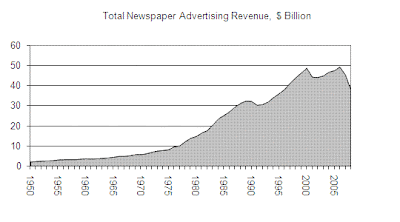
New York Times Co., Gannett Co., Media General , and McClatchy Co. have all reported profits in the second quarter and the results have led to share prices doubling and tripling. The developments must come as a surprise to those who saw the poor performance of recent quarters and convinced themselves that the newspaper industry is dead and gone. Admittedly, the positive results in the past 3 months were achieved through restructuring, reducing news staffs to their 1970s levels, heavy cost cutting everywhere, and postponing reinvestments. But it shows there is still life in the industry and that the industry can be expected to recover in the coming year if economic conditions continue their current rate of improvement. As I have said many times, a industry with $50 billion in revenue is not going to ignore that revenue, close the doors, and disappear overnight. Many have viewed the poor company performance in the past 2 years and then mistaken the steep concurrent drop in advertising as...

ONLINE AGGREGATORS AND NEWSPAPER STRATEGY

Google, MSN, and Yahoo and other aggregators are cited by newspaper executives are harming newspapers. But what have they actually done? It is important to have a realistic understanding of their effects if one is to fashion strategies for the future of newspapers and news organizations. Aggregators carry news stories from major news services and thus make international and national public affairs, entertainment and sports news widely available. The headline news on the aggregators’ home pages is becoming the primary news provider for those less interested in news and the online sections are well-used by news consumers who want more news or more timely news than appears in their daily newspaper. Aggregators and others sites carrying content from news services are now contributing about 20 percent of the revenue of Associated Press, for example, taking some financial pressure off newspapers to fund the cooperative on their own. Other news services are also gaining income from online ope...

The Challenges of Online News Micropayments and Subscriptions

The impetus toward subscriptions for access and micropayments for single use of online news is growing because online advertising alone cannot sustain the news organizations necessary to provide high quality and broad coverage. In recent weeks Rupert Murdoch announced News Corp. will begin shifting its newspapers to an online paid model in the next 12 months, starting with Wall Street Journal and then progressively shifting papers such as the New York Post, The Times of London, the Sun and The Australian to a paid model. Dean Singleton followed by indicating MediaNews Group will begin doing the same for its papers, including Denver Post, San Jose Mercury News, Detroit News, St. Paul Pioneer Press, and Salt Lake city Tribune. Clearly charging for online news is likely to reduce online consumption because of elasticity of demand, but—setting aside the extent to which demand for online news will fall if a price is imposed—moving to a paid model will also creates two common, industrywide c...

Seeing through the Haze Surrounding Websites, Blogs and Social Media

Communicating regularly is hard work. It takes skill; it takes a voice; it takes having something to say; it takes time. Making money from it is even harder. The functions provided by websites, blogs, and social media clearly make it possible for people to express themselves in ways never before imagined, to share their opinions, to express their hopes and dreams, and to share the details of their lives. Media companies are watching these developments and many are rushing to provide content on any communication technology or application the public uses. Although large numbers of people are trying the new technologies, they are reacting to them in different ways. Some find them highly useful and satisfying; some find them worthless and disappointing; some find them a worthy pastime; others find them a waste of time. What this means is that—like all technologies—they are more important to some people than to others. Consequently, managers need to be realistic in assessing their potential...

THE WILD AND WOOLLY WORLD OF CABLE, SATELLITE AND BROADBAND MARKETING

Increasing competition among cable, satellite, and broadband suppliers, combined with slower growth in consumer uptake because the industries have reached maturity, is leading to aggressive marketing efforts to wrestle market share from other companies. If the leading companies followed classic marketing strategies, they would be offering consumers better arrays of networks and services, better customer service, and/or better prices in efforts to attract more customers. Instead, many of the largest competitors have been engaging in acts that harm customers and consumers by using illegal and deceptive marketing practices and strategies designed to unwittingly wring greater revenue from their customers. Although the companies apparently think there are benefits in behaving badly, their marketing practices are increasingly getting them into trouble. Aggressive telemarketing—which has always offended consumers—has landed a number of leading firms in hot water. Comcast and Direct TV have ju...

EVERYONE'S NOT ATWITTER

Journalists and technology writers are enamored with communications technology and tend to portray successful technologies as representing large scale trends. We are regularly presented with news stories and promotional materials about the rise of new technologies and about how their uses create social trend that are significantly altering society. The release of the new iPhone was recently featured on network evening news, Blackberry has been heavily discussed because its use by Pres. Obama, and Twitter has been featured in numerous television and newspaper stories. The impression given by coverage is that anyone who doesn’t have an iPhone or Blackberry and anyone who doesn’t Twitter is out of touch with the mainstream and being left out of modern society. These new means of communications offer interesting possibilities, but their consumption needs to be seen realistically. Blackberry, for example, has 14 million subscribers-- about 5 percent of all mobile phone users in the US. iPho...