Posts

Showing posts with the label audiences

Ambient news: All the news most people want

Ambient news is proving a significant challenge to news organizations trying to serve readers on multiple digital platforms and maintain their print and broadcast news operations. Contemporary technologies all around us are now delivering breaking news, sports scores, and market updates on electronic screens and displays in elevators, taxis and buses, bars and restaurants, on the sides of buildings, through smartphones, and via social media. In years past, we all had to deliberately turn to newspapers or radio and television newscasts, or at least glance at headlines at news stands, to get a quick overview of major events. That era is past. Today news is free and ubiquitous and, unfortunately, provides all the news that most people want. This is bad news for those trying to provide news commercially. In the past, newspapers and newscasts filled their space and time with non-news features and information designed to attract audiences that wanted only a little news. M...

[Re-] establishing the relevance of legacy news organizations

Legacy news organizations (newspapers, magazines, and broadcasters) are confronting three critical relevance challenges as the digital world matures: Changing business configurations and characteristics, declining value of traditional news and informational content, and unhealthy attitudes toward audiences. These challenges will need significant attention if they are to be successful in the new information environment.   During the twentieth century news products were widely used, fast-moving consumer goods. Because media operated in relatively inefficient markets, news organizations were cash-producing investments with high cash flows that yielded high profits. Newspapers had asset-heavy balance sheets and excellent equity positions. The business drivers of the legacy news industry in the latter half of the twentieth century were g rowing consumption in absolute audience sizes (but declining penetration that most executives ignored). Companies changed high prices for advertis...

NBC's Olympic Coverage Shows Audience Expectations Aren't in Its Cross Media Strategy

NBC’s Olympic coverage in the U.S. reveals the conflict media companies face as they try to simultaneously manage traditional media delivery and digital distribution. The company is getting it right with the traditional broadcasts, garnering excellent audiences and more than $1 billion in advertising—a figure that surprised even its most optimistic executives and may allow the broadcaster to break even on the games which have traditionally been a loss leader for the company. The company is also giving audiences more coverage than every before by streaming additional content on cable channels and digital live streams. These are provided on platforms that consumers have come to expect will give them the power to choose when, where, and on what device they will be viewed.   In order to support its traditional, advertising supported services, however, NBC has used tape delays on the broadcast services and has excluded many sports or blacked them outs on live streams—ange...

Letting go: Making sense of social magazines and news readers

Applications that aggregate articles based on what others in one’s social network are reading and reformat them into an attractive magazine and presentation formats are growing in popularity, but they are raising concern among some publishers. The processes build upon the referral and curating functions of colleagues and friends in social networks and reduce the need for users to go to multiple sites for content on their own. Some of the best known social magazines are Flipboard, Newsmix, Currents, and Pulse. Some publishers are starting their own social reading apps, such as New York Times that has a Facebook app pulling together stories that friends have read in NYT. Many publishers are fearful of these developments, however, because they represent another step away from publishers controlling when, where, and how readers use their content, reduce the impact of the publishers’ brand strategies, and diminish control over the presentation and marketing of their content. But publish...

The thorny problem of media pluralism

The term pluralism is regularly used in critiques of media and in arguments for public intervention. It is employed so loosely, however, that it allows varied interpretations to be attached and this makes it highly challenging to turn general support for the concept into specific policy. Much of the lack of clarity is the consequence of indefiniteness of the term and because it is used as a proxy for more involved concepts. The term is derived from “plural”, an indistinct quantitative concept indicating the existence of more than a single thing and plurality itself merely indicates a state of being numerous. This alone allows the term plurality to be used in various ways when applied to media. For some it means a plurality of media outlets. This is indicated by having multiple types of media and multiple units of each media and the existence of a range of print, broadcast, satellite, and Internet content providers can represent pluralism. For other observers pluralism means plurality i...

How to Destroy Your Customer Base and Investor Confidence

Netflix used to have a charmed life. This year, however, poorly thought out strategy and lurching decisions are stripping away many of its advantages and making it vulnerable to competitors. Established in 1997, its founders saw opportunities in creating an Internet-based DVD-by-mail distribution system. It was designed to be a competitor to physical video stores, making it more attractive by offering a larger selection and using a unique IT driven distribution system that combined distribution centers across the country to serve customers within 24 hours at highly attractive prices. The DVD-by-mail service became a hit, ultimately devastating the market of physical stores such as Blockbuster. By 2007 it had delivered more than 1 billion DVDs to customers. That same year it launched on-demand video streaming service so customers could also select a video and stream it to a PC (and later other platforms) for immediate viewing. The company allowed viewers a h...

FCC Moves to Give Viewers Choice and Provide More Competition on Cable Systems

The U.S. Federal Communications Commission has adopted rules designed to halt cable system operators from retaliating against independent channels when there are business disputes or discriminating against them in favor of ones in which they ownership stakes. The rules are intended to ensure that the monopoly power of cable operators is not used to deny viewer choice or harm competition channel providers. One rule is designed to prohibit systems from dropping channels when there are business disputes with systems that have been taken to the commission for resolution. Another rule is designed to create a more level playing field for independent channels by making it possible for them to reach more viewers. Comcast Corp., for example, has been accused in recent years of forcing competitors’ sports channels into premium packages that fewer viewers select. Given that price rises for cable services have far outstripped inflation rates in recent years, that service providers cr...

MySpace Sale Underscores the Risks of Exuberant Digital Investments

The decision by News Corp. to dump MySpace once again reveals the risks of over exuberance toward digital companies that do not have a proven business model or long-term customer loyalty. There are plenty of digital investments that meet those requirements, but a number of the most hyped firms moving toward IPOs and acquisitions do not. They need to be considered with hard headed pragmatism. MySpace was launched 2003 and rapidly became the toast of the digital world as a social networking site and “the place” for musical stars and fans to connect. By 2005 it was the fifth most visited site on the Internet. New Corp., which was anxious to benefit from growth in digital media, jumped at the opportunity to acquire the service and paid $580 million in 2005. It was an enormous price for a company with an unclear revenue potential. Within two years MySpace had grown to be the world’s number one social networking site and was receiving 100 million unique monthly visitors. But it still had rev...

Competitive Struggles Among Television Platforms

Since the emergence of cable and satellite television services there has been struggles among platforms to increase their attractiveness to audiences and to draw market share from terrestrial television in developed nations. These struggles have had affected content producers, broadcasters, platform operators and regulators attempting to fashion socially optimal broadcasting systems. In the first competitive struggles between terrestrial broadcasters and cable operators, broadcasters controlled the highest quality contemporary programming and cable operators primarily competed by offering a wider variety of channels and providing premium movie channels. In many locations broadcasters actively sought regulatory policies to keep their channels from appearing on cable in order to reduce its attractiveness as a competitor. As cable matured and satellite services emerged, the nature of the struggle shifted as greater subscription and advertising revenues allowed cable networks to o...

Challenges of Product Choices and Prices in Multi-Sided Media Markets

Image
Commercial media have faced product and price challenges in 2-sided markets for more than a century, but are encountering greater difficulties in getting it right as they try to effectively monetize multi-sided markets. 2-sided and multi-sided markets are ones in which more than one set of consumers must be addressed and there is an interaction between strategies and choices for each set of customers. Prices for one group of consumers affects their consumption quantity and this, in turn, affects the prices for and consumption by the other groups. Optimal revenues can only be achieved by dealing with all groups of consumers simultaneously. Newspapers are a classic example of 2-sided platforms. The first product is the content sold to audiences and the second is access to audiences that is sold to advertisers. This has been the basis of the mass media business model since late 19th century and the strategy has been to keep circulation prices low to attract a mass audience and then to mak...

SEARCH FOR ALTERNATIVE MEDIA BUSINESS MODELS HAMPERED BY NARROW THINKING

Media executives around the globe are clamoring for new and alternative business models and industry associations everywhere are holding seminars and conferences on how to create and discover them. There is just one problem: They don’t know what business models are. When you cut through the rhetoric, you find that most executives are merely interested in finding new revenue streams. Even when you consider firms touted as having best practices in that regard, none have been very successful in establishing them. The reason is simple: The dominant thought about business models is highly limited and far too narrow to solve the contemporary challenges of media industries. Business models are not merely about the revenue streams. Instead, they establish the underlying business logic and elements. They involve the foundations upon which businesses built, such as companies’ competences, value created, products/services provided, customers served, relationships established with customers and pa...

NEWS HAS NEVER BEEN A COMMERCIALLY VIABLE PRODUCT

Industry, scholarly and policy discussions about the future of the news industry in North America and Europe continue to focus on how news enterprises can sustain themselves in the 21st century. Publishers keep asserting that things will be fine if they can erect pay walls and charge for news online and they argue that governments should provide legal protections for online news so they can make news a viable digital business product. Their approach is wrong and ignores the fundamental reality that news has never been a commercially viable product because most of the public has been, and remains, unwilling to pay for news. Consequently, news has always been funded with income based on its value for other things. Historically, the first collection and dissemination of news was funded in ancient times by emperors and kings, who used governors and officials throughout their realms to collect news and information and send it to the seat of power. Emissaries, consuls, and ambassadors collec...

HONOLULU JOINS THE RANKS OF NEWSPAPER MONOPOLY CITIES

I was sorting through some of my father’s belonging recently and came across the 1941 souvenir edition of the Honolulu Star-Bulletin (Jan 8, 1941), “The March of Hawaii.” Its lead story was the reorganization and strengthening of the Pacific Fleet and the appointment of Admiral H.E. Kimmel to head it. My father acquired the paper while stationed in Hawaii with the Army Air Corps. Eleven months later the U.S. was at war, with Kimmel taking heat for having the bulk of his capital ships anchored in Pearl Harbor during the Japanese attack. I was reminded of the find this week while reading the news that Gannett has agreed to sell the Honolulu Advertiser to the Star-Bulletin . The two have a 130-year history of competition, somewhat muffled until they escaped their relatively difficult marriage in a joint operating agreement between 1960s and the millennium. Now the smaller paper is buying the bigger paper, if it can comply with or skirt antitrust provisions. We are now in the last throes...

4 STRATEGIC PRINCIPLES FOR EVERY DIGITAL PUBLISHER

As publishers move more and more content to the Internet, mobile services, and e-readers, these digital activities change the structures and processes of underlying business operations. Many publishers, however, pay insufficient attention to the implications of these changes and thus miss out on many benefits possible with digital operations. This occurs because publishers become focused on issues of content delivery and uncritically accept the fundamental elements of the processes involving platforms and intermediaries. In order to gain the fullest future benefits from the digital environment, however, publishers needs to strategically consider and direct activities involving the users, advertisers, prices, and purposes of their new platforms. In creating business arrangements with platform and service providers and intermediaries, 4 fundamental strategic principles should guide your actions: 1. Control your customer lists . The most important thing you do as a publisher is to create ...

THE TRANSACTION COST PROBLEM OF NEWSPAPER MICROPAYMENTS

The desire to monetize online news is leading some to enthusiastically promote micropayment systems. A number of the leading newspaper sites are leaning toward a cooperative payment system that will allow readers to use a single account to access material at the leading papers. Such a system will not be technically difficult to implement, but getting the price right will be a significant challenge because of transaction costs and significant differences in the economic value of articles. To create the best industry wide effects, a micropayment payment system would need to include as many papers as possible (see "The Challenges of Online News Micropayments and Subscriptions" http://themediabusiness.blogspot.com/2009/05/challenges-of-online-news-micropayments.html ). The fact that a consortium is currently being sought only among the major players illustrates, however, that such a system would be cost inefficient because content from smaller papers would attract fewer transacti...

PROFITS, RECESSION, AND RECOVERY

Image
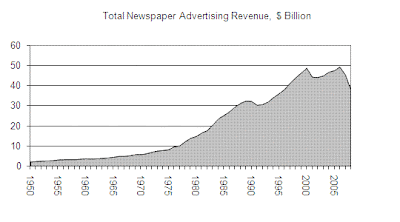
New York Times Co., Gannett Co., Media General , and McClatchy Co. have all reported profits in the second quarter and the results have led to share prices doubling and tripling. The developments must come as a surprise to those who saw the poor performance of recent quarters and convinced themselves that the newspaper industry is dead and gone. Admittedly, the positive results in the past 3 months were achieved through restructuring, reducing news staffs to their 1970s levels, heavy cost cutting everywhere, and postponing reinvestments. But it shows there is still life in the industry and that the industry can be expected to recover in the coming year if economic conditions continue their current rate of improvement. As I have said many times, a industry with $50 billion in revenue is not going to ignore that revenue, close the doors, and disappear overnight. Many have viewed the poor company performance in the past 2 years and then mistaken the steep concurrent drop in advertising as...

ONLINE AGGREGATORS AND NEWSPAPER STRATEGY

Google, MSN, and Yahoo and other aggregators are cited by newspaper executives are harming newspapers. But what have they actually done? It is important to have a realistic understanding of their effects if one is to fashion strategies for the future of newspapers and news organizations. Aggregators carry news stories from major news services and thus make international and national public affairs, entertainment and sports news widely available. The headline news on the aggregators’ home pages is becoming the primary news provider for those less interested in news and the online sections are well-used by news consumers who want more news or more timely news than appears in their daily newspaper. Aggregators and others sites carrying content from news services are now contributing about 20 percent of the revenue of Associated Press, for example, taking some financial pressure off newspapers to fund the cooperative on their own. Other news services are also gaining income from online ope...

The Challenges of Online News Micropayments and Subscriptions

The impetus toward subscriptions for access and micropayments for single use of online news is growing because online advertising alone cannot sustain the news organizations necessary to provide high quality and broad coverage. In recent weeks Rupert Murdoch announced News Corp. will begin shifting its newspapers to an online paid model in the next 12 months, starting with Wall Street Journal and then progressively shifting papers such as the New York Post, The Times of London, the Sun and The Australian to a paid model. Dean Singleton followed by indicating MediaNews Group will begin doing the same for its papers, including Denver Post, San Jose Mercury News, Detroit News, St. Paul Pioneer Press, and Salt Lake city Tribune. Clearly charging for online news is likely to reduce online consumption because of elasticity of demand, but—setting aside the extent to which demand for online news will fall if a price is imposed—moving to a paid model will also creates two common, industrywide c...

Seeing through the Haze Surrounding Websites, Blogs and Social Media

Communicating regularly is hard work. It takes skill; it takes a voice; it takes having something to say; it takes time. Making money from it is even harder. The functions provided by websites, blogs, and social media clearly make it possible for people to express themselves in ways never before imagined, to share their opinions, to express their hopes and dreams, and to share the details of their lives. Media companies are watching these developments and many are rushing to provide content on any communication technology or application the public uses. Although large numbers of people are trying the new technologies, they are reacting to them in different ways. Some find them highly useful and satisfying; some find them worthless and disappointing; some find them a worthy pastime; others find them a waste of time. What this means is that—like all technologies—they are more important to some people than to others. Consequently, managers need to be realistic in assessing their potential...

PERFORMANCE PROBLEMS SHAKE MYSPACE

The high hopes that News Corp. had for MySpace when it paid $580 million in for the social networking site in 2005 have never been realized and appear more elusive than ever. Consequently, MySpace co-founders Chris DeWolfe (who is CEO) and Tom Anderson (who is President) are being pushed out of their management roles in major shakeup of the company's leadership. The move is signals News Corp’s concern over the site’s declining market share and poor returns. In the past three years Facebook has surpassed MySpace in total number of users worldwide, but MySpace has managed to remain the largest site in the U.S. and has 130 million users globally. In 2008 the company had estimated advertising revues of $585 million, with the bulk coming from its ad-sharing deal with Google. But it will take a long, long time for News Corp. to recoup its investment at that pace. That revenue problem is compounded because Google has been unhappy with its MySpace deal and is unlikely to continue it at pre...