Posts

Showing posts with the label advertisers

European private TV has matured, but needs new strategies for development

The European television industry is one of the most balanced in the world, with public service broadcasters, advertising-supported broadcasters, and pay television operators reasonably dividing television revenues among themselves. For the 27 countries of the EU, pay TV accounts for about 38% of total revenue, public funded broadcasters for about 34%, and advertiser supported television for about 28%.   Unlike the US where private television dominates, most Europe private television began after liberalization broke the monopolies held by public service and state television in most countries. It has taken decades for private television to establish a mature place in the market.   When looking specific countries, however, total spending on TV (advertising, subscriptions, public funding) is not evenly spread. Adjusted for population, it ranges between €5 and €30 per person among nations, with an average of €15. There a notable differences between southern, central, and ...

[Re-] establishing the relevance of legacy news organizations

Legacy news organizations (newspapers, magazines, and broadcasters) are confronting three critical relevance challenges as the digital world matures: Changing business configurations and characteristics, declining value of traditional news and informational content, and unhealthy attitudes toward audiences. These challenges will need significant attention if they are to be successful in the new information environment.   During the twentieth century news products were widely used, fast-moving consumer goods. Because media operated in relatively inefficient markets, news organizations were cash-producing investments with high cash flows that yielded high profits. Newspapers had asset-heavy balance sheets and excellent equity positions. The business drivers of the legacy news industry in the latter half of the twentieth century were g rowing consumption in absolute audience sizes (but declining penetration that most executives ignored). Companies changed high prices for advertis...

Changing frequency of newspaper publication is not a sign of the apocalypse

The number of newspapers that have reduced their publication frequency in response to market changes and economic conditions continues to rise. This year the  Times-Herald in Newnan, Georgia shifted from 7 days a week to 5 days per week. The New Orleans Times-Picayune moved to 3-day per week schedule, as has The Patriot-News in Harrisburg, Pa., and many papers in the Advance Publications group. In doing so, the papers are bolstering their digital publications and producing in physical form only on days that most interest retail advertisers. From the financial standpoint, these moves make a great deal of sense. Reactions to the changes have ranged from disbelief to resignation in the journalism community. Many have bemoaned the loss of dailies and argued non-dailies cannot possibly serve their communities as well. That argument is problematic, of course, because there have typically been 3-4 times more weeklies than dailies in the U.S. and many have done far better jobs...

Canadian Media Merger Creates High Market Power and Runs Against Concentration Trends Elsewhere

The proposed merger between Bell Canada Enterprises and Astral Media will shortly be considered by the Canadian Radio and Television Council (CTRC). The merged company will own 70 television and cable channels, more than 100 radio stations, and some of the country’s most popular websites. The combined company will serve nearly one-third of the national TV audience, more than 40 percent of the national cable TV audience, and about 30 percent of the nationwide radio audience. In addition the merger will increase Bell’s vertical integration and its power over distribution systems used by competitors. This later factor is particularly important because Canada lacks much of the regulatory control seen in Europe and the US over business practices of distribution systems that are also used by competing firms. The merger will benefit the two companies by giving them more market power and permitting efficiencies at the corporate and divisional levels. It is also likely to produce efficienc...

NBC's Olympic Coverage Shows Audience Expectations Aren't in Its Cross Media Strategy

NBC’s Olympic coverage in the U.S. reveals the conflict media companies face as they try to simultaneously manage traditional media delivery and digital distribution. The company is getting it right with the traditional broadcasts, garnering excellent audiences and more than $1 billion in advertising—a figure that surprised even its most optimistic executives and may allow the broadcaster to break even on the games which have traditionally been a loss leader for the company. The company is also giving audiences more coverage than every before by streaming additional content on cable channels and digital live streams. These are provided on platforms that consumers have come to expect will give them the power to choose when, where, and on what device they will be viewed.   In order to support its traditional, advertising supported services, however, NBC has used tape delays on the broadcast services and has excluded many sports or blacked them outs on live streams—ange...

Digital journalism reaches sustainability, but transitional business problems interfere

The income streams of digital news providers continue to grow and many have now reached the point of sustainability. Fundamental financial and business problems, however, are keeping publishers from moving out of print and becoming digital-only operators. This leads many publishers and journalists to continue bemoaning the fact that digital media do not provide as much income as print and many still argue that organized, regular newsgathering and distribution cannot survive in a digital-only environment. They point to the fact that digital advertising produces only about 15 percent the income of print advertising—largely because it does not appeal to retail, display advertisers--and that paid circulation for digital products is growing slowly. Their analysis is flawed, however, because publishers do not require as much revenue online as offline because the costs of digital operation are so different. Editorial operations account for only about 10-15 percent of total costs of opera...

Is the future of digital journalism an outside job?

Making small digital news providers sustainable has become the holy grail of journalists and the search continues for workable business models and revenue streams. Advertising may produce some revenue, but it will never generate sufficient resources to support digital journalism because so little advertising money is available for sites with small audiences. About three-quarters of all online advertising goes to the top 10 sites and Google, Facebook, Microsoft, and Yahoo account for about 60 percent of all online revenue. This leaves very little advertising expenditures to be contested among all other players--of which news providers are only a small fraction. At the same time, the prices paid for online advertising are falling because there are so many sites offering advertising, the advertising inventory is nearly infinite, and audiences continue fragmenting. This means the majority of funding for start-up digital journalism must come from elsewhere and online news sites—especially s...

Google, Newspaper Archives, and the Business of Cultural Heritage

Google announced this month that it is ending its ambitious project to digitally archive newspapers. The project to scan the archives of the nation’s newspapers and make them available online as a searchable historical record was announced in 2008 with the level of hubris only found in online enterprises. "Our objective is to bring all the world's historical newspaper information online,” said Adam Smith, director of product management at Google, announcing the project. Those lofty aims were echoed by Punit Soni, manager of the newspaper initiative: “As we work with more and more publishers, we'll move closer towards our goal of making those billions of pages of newsprint from around the world searchable, discoverable, and accessible online…."Over time, as we scan more articles and our index grows, we'll also start blending these archives into our main search results so that when you search Google.com, you'll be searching the full text of these newspapers as w...

Competitive Struggles Among Television Platforms

Since the emergence of cable and satellite television services there has been struggles among platforms to increase their attractiveness to audiences and to draw market share from terrestrial television in developed nations. These struggles have had affected content producers, broadcasters, platform operators and regulators attempting to fashion socially optimal broadcasting systems. In the first competitive struggles between terrestrial broadcasters and cable operators, broadcasters controlled the highest quality contemporary programming and cable operators primarily competed by offering a wider variety of channels and providing premium movie channels. In many locations broadcasters actively sought regulatory policies to keep their channels from appearing on cable in order to reduce its attractiveness as a competitor. As cable matured and satellite services emerged, the nature of the struggle shifted as greater subscription and advertising revenues allowed cable networks to o...

Challenges of Product Choices and Prices in Multi-Sided Media Markets

Image
Commercial media have faced product and price challenges in 2-sided markets for more than a century, but are encountering greater difficulties in getting it right as they try to effectively monetize multi-sided markets. 2-sided and multi-sided markets are ones in which more than one set of consumers must be addressed and there is an interaction between strategies and choices for each set of customers. Prices for one group of consumers affects their consumption quantity and this, in turn, affects the prices for and consumption by the other groups. Optimal revenues can only be achieved by dealing with all groups of consumers simultaneously. Newspapers are a classic example of 2-sided platforms. The first product is the content sold to audiences and the second is access to audiences that is sold to advertisers. This has been the basis of the mass media business model since late 19th century and the strategy has been to keep circulation prices low to attract a mass audience and then to mak...

NEWS HAS NEVER BEEN A COMMERCIALLY VIABLE PRODUCT

Industry, scholarly and policy discussions about the future of the news industry in North America and Europe continue to focus on how news enterprises can sustain themselves in the 21st century. Publishers keep asserting that things will be fine if they can erect pay walls and charge for news online and they argue that governments should provide legal protections for online news so they can make news a viable digital business product. Their approach is wrong and ignores the fundamental reality that news has never been a commercially viable product because most of the public has been, and remains, unwilling to pay for news. Consequently, news has always been funded with income based on its value for other things. Historically, the first collection and dissemination of news was funded in ancient times by emperors and kings, who used governors and officials throughout their realms to collect news and information and send it to the seat of power. Emissaries, consuls, and ambassadors collec...

HONOLULU JOINS THE RANKS OF NEWSPAPER MONOPOLY CITIES

I was sorting through some of my father’s belonging recently and came across the 1941 souvenir edition of the Honolulu Star-Bulletin (Jan 8, 1941), “The March of Hawaii.” Its lead story was the reorganization and strengthening of the Pacific Fleet and the appointment of Admiral H.E. Kimmel to head it. My father acquired the paper while stationed in Hawaii with the Army Air Corps. Eleven months later the U.S. was at war, with Kimmel taking heat for having the bulk of his capital ships anchored in Pearl Harbor during the Japanese attack. I was reminded of the find this week while reading the news that Gannett has agreed to sell the Honolulu Advertiser to the Star-Bulletin . The two have a 130-year history of competition, somewhat muffled until they escaped their relatively difficult marriage in a joint operating agreement between 1960s and the millennium. Now the smaller paper is buying the bigger paper, if it can comply with or skirt antitrust provisions. We are now in the last throes...

THE WIDENING RANGE OF REVENUE SOURCES IN NEWS ENTERPRISES

It is obvious that both the offline and online news providers are in the midst of substantial transformation and that the traditional means of funding operations are no longer as viable as in the past. This is disturbing to the industry because it has enjoyed several decades of unusual financially wealth and few in the organizations know how to find and generate new sources of revenue. The financial uncertainty facing the industry is not unusual, however. We tend to forget that news has historically been unable to pay for itself and was subsidized by other activities. In the past newspapers and other news organizations engaged in a far larger range of commercial activities than then they do today and publishers had to be highly entrepreneurial and seek income from a wide variety of sources in order to survive. The initial gathering and distribution of news was paid for by emperors, monarchs, and other rulers who needed information for state purposes. Later, wealthy international mercha...

4 STRATEGIC PRINCIPLES FOR EVERY DIGITAL PUBLISHER

As publishers move more and more content to the Internet, mobile services, and e-readers, these digital activities change the structures and processes of underlying business operations. Many publishers, however, pay insufficient attention to the implications of these changes and thus miss out on many benefits possible with digital operations. This occurs because publishers become focused on issues of content delivery and uncritically accept the fundamental elements of the processes involving platforms and intermediaries. In order to gain the fullest future benefits from the digital environment, however, publishers needs to strategically consider and direct activities involving the users, advertisers, prices, and purposes of their new platforms. In creating business arrangements with platform and service providers and intermediaries, 4 fundamental strategic principles should guide your actions: 1. Control your customer lists . The most important thing you do as a publisher is to create ...

RADIO STATIONS FACE SIGNIFICANT STRATEGIC CHALLENGES

Fundamental market changes are pushing radio stations towards an uncertain future and managers and owners need to begin developing strategic responses to developments in their industry. The challenges are being caused by declining demand for radio offerings due to lifestyle changes, the wide availability of substitutable audio platforms, and the primary content currently being offered. Audience behavior toward radio is changing and many U.S. stations now only make money for 4 to 6 hours each day. Overall, audiences are spending less time with radio and exhibiting less station loyalty than they did in the past, and young audiences are particularly difficult to attract and serve. A major impetus of change is that audiences for music worldwide are progressively replacing radio listening with personalized playlists they have created on their computers, MP3 players, and mobile phones and by CDs on which they burned those favorites. They select music that suits their individual tastes and ma...

PROFITS, RECESSION, AND RECOVERY

Image
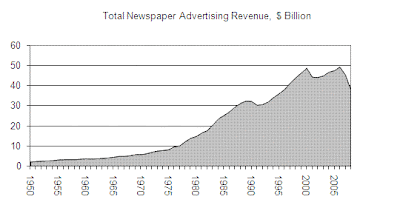
New York Times Co., Gannett Co., Media General , and McClatchy Co. have all reported profits in the second quarter and the results have led to share prices doubling and tripling. The developments must come as a surprise to those who saw the poor performance of recent quarters and convinced themselves that the newspaper industry is dead and gone. Admittedly, the positive results in the past 3 months were achieved through restructuring, reducing news staffs to their 1970s levels, heavy cost cutting everywhere, and postponing reinvestments. But it shows there is still life in the industry and that the industry can be expected to recover in the coming year if economic conditions continue their current rate of improvement. As I have said many times, a industry with $50 billion in revenue is not going to ignore that revenue, close the doors, and disappear overnight. Many have viewed the poor company performance in the past 2 years and then mistaken the steep concurrent drop in advertising as...

ONLINE AGGREGATORS AND NEWSPAPER STRATEGY

Google, MSN, and Yahoo and other aggregators are cited by newspaper executives are harming newspapers. But what have they actually done? It is important to have a realistic understanding of their effects if one is to fashion strategies for the future of newspapers and news organizations. Aggregators carry news stories from major news services and thus make international and national public affairs, entertainment and sports news widely available. The headline news on the aggregators’ home pages is becoming the primary news provider for those less interested in news and the online sections are well-used by news consumers who want more news or more timely news than appears in their daily newspaper. Aggregators and others sites carrying content from news services are now contributing about 20 percent of the revenue of Associated Press, for example, taking some financial pressure off newspapers to fund the cooperative on their own. Other news services are also gaining income from online ope...

THE POOR CONNECTION BETWEEN INTERNET ADVERTISING AND NEWSPAPER WOES

Image
Self deception is more damaging than lies told to us by others because it more strongly affects our perceptions and decisions. One of the biggest self deceptions in the newspaper industry today is that the Internet is striping newspapers of advertising dollars and is a primary cause of its economic woes. There is no question that Internet is increasingly attracting advertising revenues. They reached $23.4 billion in the U.S. in 2008. Looking at the numbers more closely, however, one sees a different story. About half those expenditures are search and lead generation fees that don’t compete with traditional newspaper advertising. Search payments alone are the single largest category of Internet income and represent 40% of total online fees. Internet classified advertising—the direct competitor to newspaper classifieds—has never exceeded 20 percent of online advertising revenues and it is declining as a percentage of the total. Online classified advertising was $3.2 billion in 2008, abou...

PERFORMANCE PROBLEMS SHAKE MYSPACE

The high hopes that News Corp. had for MySpace when it paid $580 million in for the social networking site in 2005 have never been realized and appear more elusive than ever. Consequently, MySpace co-founders Chris DeWolfe (who is CEO) and Tom Anderson (who is President) are being pushed out of their management roles in major shakeup of the company's leadership. The move is signals News Corp’s concern over the site’s declining market share and poor returns. In the past three years Facebook has surpassed MySpace in total number of users worldwide, but MySpace has managed to remain the largest site in the U.S. and has 130 million users globally. In 2008 the company had estimated advertising revues of $585 million, with the bulk coming from its ad-sharing deal with Google. But it will take a long, long time for News Corp. to recoup its investment at that pace. That revenue problem is compounded because Google has been unhappy with its MySpace deal and is unlikely to continue it at pre...

ANALYSIS OF THE NEWSPAPER REVITALIZATION ACT

The Newspaper Revitalization Act introduced by Sen. Benjamin Cardin, D-Md., would permit newspapers to operate as not-for-profit entities under the tax code and is being heralded by some observers as a means of saving newspapers, much as was the Newspaper Preservation Act of 1970. Good purposes aside, it is useful to study the act to determine whether it will actually accomplish the goals that are stated as its rationale. The bill is a small bill, about 435 words, that would amend the IRS Code of 1986 to permit newspapers to be given 501(c)(3) status, thus obtaining tax exempt status and the ability to accept charitable contributions. Currently tax laws do not permit newspapers to be operated tax exempt, but they do have mechanisms that permit foundations to own them or support them financially. Paragraph (b)(1) of the bill would allow general circulation newspapers “publishing on a regular basis” to establish themselves as tax exempt organizations. The language does not limit periodic...